
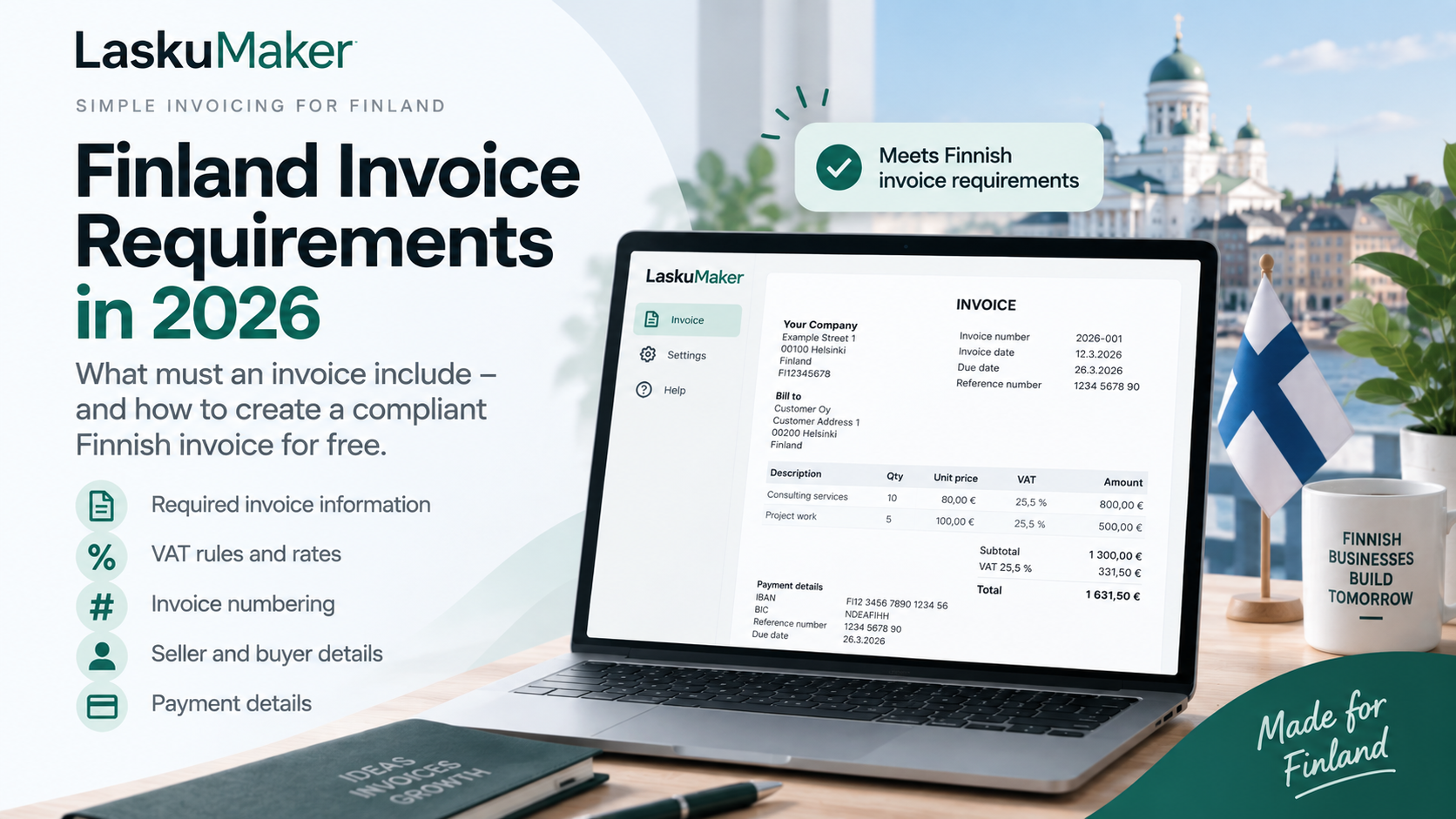
Creating an invoice in Finland involves more than adding your company name, the amount due, and your bank account number. Depending on the transaction, Finnish VAT rules require invoices to contain specific information.
For freelancers, entrepreneurs, and small businesses, understanding these Finland invoice requirements is important for accurate bookkeeping, VAT reporting, and professional billing.
The good news is that you don’t have to build every invoice manually. LaskuMaker.fi is a free invoice generator designed for Finnish invoicing, making it easier to prepare invoices with the key information expected in Finland.
What Are the Invoice Requirements in Finland?
For a standard VAT invoice, the Finnish Tax Administration requires information including the invoice date, a unique sequential invoice number, seller’s VAT identification number, seller and buyer names and addresses, description of the goods or services, applicable VAT information, and certain transaction dates. Additional information may be required in special circumstances. (vero.fi)
A standard Finnish VAT invoice will generally need:
- Date of issue
- Unique sequential invoice number
- Seller’s VAT identification number
- Seller’s name and address
- Buyer’s name and address
- Description and quantity of goods or nature and extent of services
- Supply or completion date when required
- Unit price excluding VAT
- VAT base for each applicable VAT rate
- Applicable VAT rate
- Total VAT payable
- Required special VAT statements where applicable
The buyer’s VAT identification number is also required in certain cases, such as when reverse charge applies or for an intra-Community supply. (vero.fi)
Let’s look at the most important requirements in more detail.
1. Invoice Date
Your invoice needs a date of issue.
This may seem obvious, but the invoice date is an important accounting detail. According to the Finnish Tax Administration, this can be the date the invoice was prepared, printed, or delivered to the purchaser. (vero.fi)
A proper invoice generator should therefore provide a clear place for the invoice date.
2. Unique Invoice Number
Every invoice should have a unique sequential number.
The purpose is to make individual invoices identifiable and help reveal gaps in invoice records. Invoices within the same accounting period cannot share the same sequential number. Businesses can, however, use multiple numbering series, and an invoice identifier does not have to contain only numbers. (vero.fi)
For example:
2026-001
2026-002
2026-003
Avoid repeatedly using vague invoice numbers such as “Invoice 1” without maintaining a consistent system.
3. Seller Information
A Finnish VAT invoice generally needs to clearly identify the seller.
This includes the seller’s name and address and, where required, the seller’s VAT identification number. (vero.fi)
This information allows the customer and accounting records to identify who issued the invoice.
4. Customer Information
The invoice should also identify the purchaser with their name and address. (vero.fi)
Depending on the type of transaction, the purchaser’s VAT identification number may also be required. This applies, for example, where the purchaser is liable for VAT under reverse charge or for intra-Community supplies of goods. (vero.fi)
Accurate customer information is particularly important when invoicing another business.
5. Description of Products or Services
An invoice should make it clear what the customer is paying for.
The Finnish VAT requirements call for the quantity and nature of supplied goods or the extent and nature of supplied services. (vero.fi)
Instead of writing:
“Work – €1,000”
a clearer description might be:
“Website design services – August 2026 – €1,000”
Clear descriptions make invoices easier for customers, accountants, and your own business records to understand.
6. Date of Supply or Service
Sometimes the invoice date and the date you actually provided the goods or services are different.
Where it can be determined and differs from the invoice date, the invoice requirements include the date on which goods were supplied, services were completed, or an advance payment was made. (vero.fi)
This can also matter when determining which VAT rate applies.
7. VAT Information
VAT is one of the most important areas to get right when creating Finnish invoices.
For VAT-liable transactions, invoices generally need to show the VAT base for each rate, the unit price excluding VAT, relevant discounts or rebates not already included in the unit price, the VAT rate, and VAT payable. (vero.fi)
If different items are subject to different VAT rates, the applicable rates need to be properly reflected.
What Is Finland’s VAT Rate in 2026?
As of 2026, Finland’s general VAT rate is 25.5% and applies to most goods and services. The reduced rate that was previously 14% decreased to 13.5% from 1 January 2026. Other VAT treatment and rates can apply depending on the goods or services concerned. (vero.fi)
Do not simply assume that every product or service uses the same VAT rate. Check the current rules for what your business sells.
8. VAT-Exempt and Special Transactions
Not every invoice follows exactly the same VAT treatment.
If a transaction is VAT-exempt, the standard invoice requirements can include an indication that the transaction is exempt or a reference to the relevant VAT provision. (vero.fi)
Reverse-charge transactions also require different invoice entries.
For example, under the reverse-charge mechanism for certain construction services, the invoice normally excludes the VAT rate and VAT amount and instead needs information including the buyer’s VAT number and an indication that reverse charge applies. (vero.fi)
This is why entrepreneurs dealing with unusual VAT situations should verify the requirements applying specifically to their transaction.
Are There Simplified Invoice Requirements in Finland?
Yes.
In certain circumstances, Finland allows simplified invoice information. Examples include invoices where the total is €400 or less, certain retail sales, restaurant and catering services, passenger transport services, and receipts produced by parking meters or similar devices. (vero.fi)
A simplified invoice generally needs information such as the invoice date, seller’s name and VAT registration number, description or category of goods or services, and VAT amounts or VAT bases broken down by applicable rate. (vero.fi)
However, don’t assume that every invoice below €400 automatically falls under the simplified rules without considering the transaction and applicable exceptions.
What About Payment Details?
Beyond the statutory VAT invoice content, an invoice also needs to be practical.
Your customer needs to know how much to pay, when to pay it, and where to send the money.
For ordinary Finnish business invoicing, useful payment information can include the total amount payable, due date, IBAN, BIC where relevant, payment terms, and reference number.
These details help turn a compliant invoice into one your customer can actually process and pay efficiently.
Common Finnish Invoice Mistakes to Avoid
Some invoicing problems come from very simple errors.
For example, an entrepreneur might forget to change an invoice number after copying an old invoice, use an outdated VAT rate, enter the wrong customer details, omit the service description, or make a calculation error.
Another mistake is assuming that a generic international invoice template automatically satisfies Finnish requirements.
Finland has its own VAT and invoicing rules, so using a tool built with Finnish invoicing in mind can simplify the process.
LaskuMaker.fi: A Free Tool for Creating Finnish Invoices
This is where LaskuMaker.fi can help.
LaskuMaker is a free online invoice generator designed specifically for Finland. Instead of manually creating an invoice layout every time, you can enter your business, customer, invoice, item, VAT, and payment information into a structured invoice generator.
For freelancers and small businesses that don’t need a large accounting platform, this can be a particularly convenient solution.
Why Use LaskuMaker?
LaskuMaker focuses on making Finnish invoice creation straightforward.
You can use it to organize the core information needed for an invoice, create professional-looking invoices, and avoid repeatedly formatting documents manually.
It is particularly useful for:
Freelancers who need to bill clients occasionally.
New entrepreneurs learning how Finnish invoicing works.
Sole traders looking for a straightforward invoice creator.
Small businesses that need professional invoices without complicated software.
International entrepreneurs in Finland who want a simple Finnish-focused invoicing tool.
Does Using an Invoice Generator Guarantee Compliance?
No invoice generator should replace your responsibility to determine the correct tax treatment of your transaction.
This is especially important for reverse charge, VAT-exempt transactions, international trade, special VAT rates, and other non-standard situations.
For example, intra-Community supplies can require the VAT numbers of both seller and buyer and an indication that the sale is exempt. (vero.fi)
The Finnish Tax Administration also states that responsibility for correct VAT markings remains with the seller in contexts such as construction reverse charge. (vero.fi)
LaskuMaker can make creating the invoice easier, but the entrepreneur remains responsible for entering correct information and applying the rules relevant to the transaction.
Finland Invoice Requirements: Quick Checklist
Before sending an invoice, check that you have included the required information for your particular transaction.
For a typical VAT invoice, ask yourself:
Is the invoice date correct?
Does the invoice have a unique sequential number?
Are the seller and customer details correct?
Is the seller’s VAT identification number included where required?
Are the products or services clearly described?
Is the supply or completion date included when required?
Are the prices and VAT bases correct?
Is the correct VAT rate being used?
Is the VAT amount correct?
Are any required VAT-exemption or reverse-charge statements included?
Can the customer clearly understand how and when to pay?
If you’re unsure about the tax treatment, verify it with the Finnish Tax Administration’s VAT invoice requirements or consult an accountant.
Frequently Asked Questions About Finland Invoice Requirements
What information is required on an invoice in Finland?
A standard Finnish VAT invoice generally requires the date of issue, unique sequential invoice number, seller’s VAT identification number, seller and purchaser names and addresses, description of goods or services, relevant supply date, VAT base, applicable VAT rate, and VAT payable. Other information may be required depending on the transaction. (vero.fi)
Does an invoice need an invoice number in Finland?
Yes, VAT invoice requirements include a unique sequential number that identifies the invoice. (vero.fi)
What is the standard VAT rate in Finland in 2026?
The general VAT rate is 25.5% and applies to most goods and services. Finland also has reduced and special VAT rates for qualifying supplies. (vero.fi)
Can I create a Finnish invoice for free?
Yes. LaskuMaker.fi provides a free online tool designed for creating Finnish invoices.
Is LaskuMaker suitable for Finnish freelancers and small businesses?
Yes. It is designed as a straightforward Finnish invoice generator for entrepreneurs, freelancers, and small businesses that want to create professional invoices without complicated invoicing software.
Create a Finnish Invoice with LaskuMaker
Understanding Finland invoice requirements is important, but creating the invoice itself doesn’t have to be difficult.
Once you know which information applies to your transaction, a Finnish-focused invoice generator can make the process much faster.
LaskuMaker.fi is one of the useful free options for entrepreneurs who want a simple tool built around Finnish invoicing. Enter your invoice details, carefully review the VAT and payment information, and create a professional invoice without having to design one from scratch.
Create your Finnish invoice for free with LaskuMaker.fi.